Case study · Aperio — autonomous marketing system
Aperio — a system that measures, prioritises and ships content
An AI tool that supports, automates and — where needed — replaces end-to-end marketing work. AI agents measure your brand visibility, set the order of work, write content in several languages and publish it to the site. Whatever they must not decide alone reaches a person with the material already prepared.
Multi-brand AI platform for SEO/AEO/GEO: measurement, prioritisation, content production and publishing in one loop — the work usually outsourced to an agency or a hire, done by agents. Designed, built and maintained by Primessio.
Primessio (ACTIVE IT) is a software house based in Warsaw: websites and online stores, custom software and IT systems, SEO and AI SEO, social media and content, branding and project management — for clients in Poland and the DACH region. Below is one of our projects.
Product demo
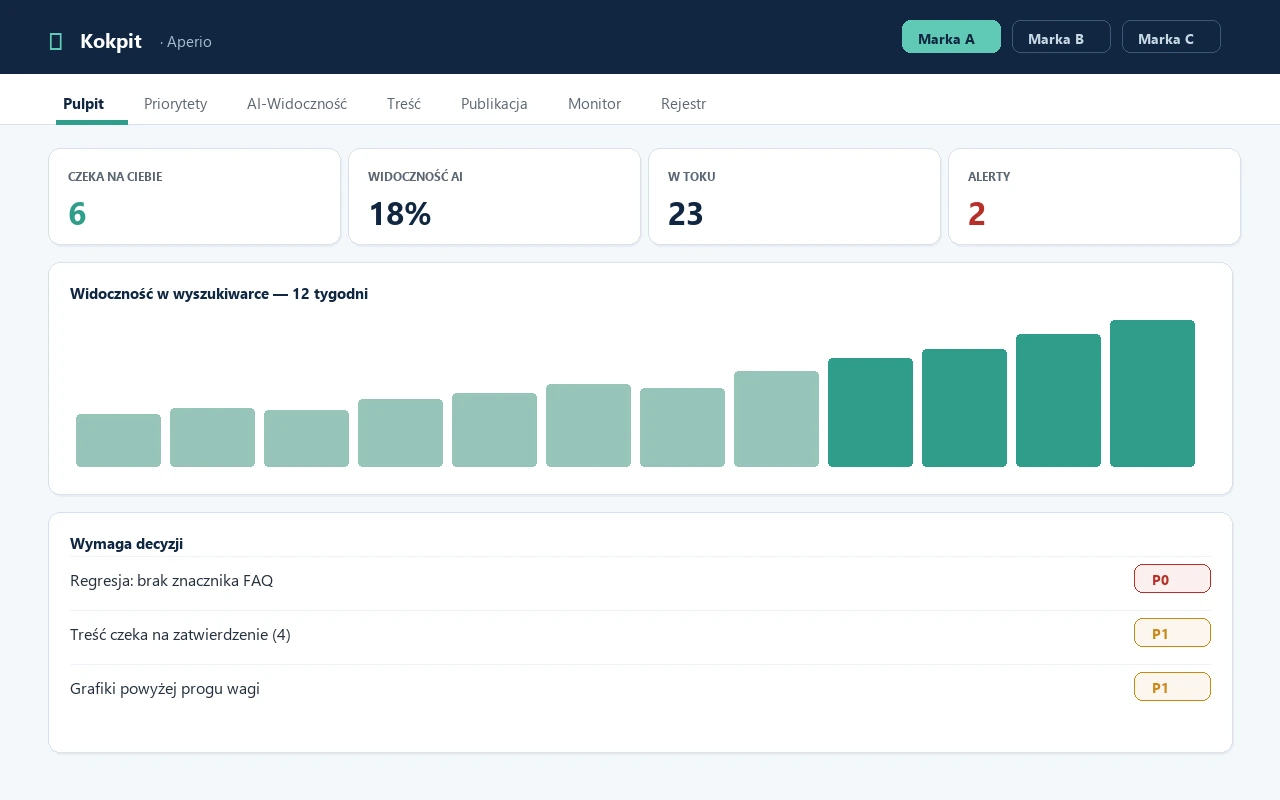
Anonymised Aperio demo — the same views and layout as in production, with sample brands and figures. Autoplay · PL / DE / EN. · Open demo in a new window ↗
Challenge
Content marketing run the classic way drifts apart on three levels at once: measurement lives in several dashboards, decisions in spreadsheets and people's heads, execution in an inbox. With one brand that is manageable. With several — in several languages, across different teams and different legal requirements — it stops being manageable.
On top of that sits a problem no report shows: work repeated because nobody remembered the topic was already closed. And its mirror image — work forgotten, because the decision was recorded in an email rather than in the system.
Solution
One closed loop: measurement feeds the task registry, the registry sets priorities, priorities trigger content production, and publishing feeds back into measurement. The registry is the single source of truth — tabs and reports are only its views, so no decision gets lost between tools.
The automation does everything it can do safely and ticks it off immediately. Where legal risk, publishing outside our own site, or money is involved, it prepares the complete material and hands the decision to a person. That boundary is built into the system, not written in a guideline.
Scope — what we delivered
Task registry
Single source of truth: statuses, owners, evidence of completion, change history. The lists in tabs are projections, not separate sources.
Measurement engines
Rankings, traffic, visibility in AI answers, content gaps, link strength, image weight — on a schedule, without being asked.
Priority engine
Signals from every engine consolidated per page: one URL becomes one priority with a list of actions, not five separate tickets.
Content production
Multi-channel packages (article, social, video) in several languages — transcreation for the market, not translation.
Rollout autopilot
Scheduled pass through priorities: safe changes shipped and ticked off at once, the rest handed over with material ready for a decision.
Publishing to the site
Shipping content to the live site with a backup, verification, and automatic rollback when publication is not confirmed.
Compliance gates
Industry and legal rules per brand — checked before the content is written, not after it is published.
Loop for teams
Working sheets for people handling tasks outside the system; their decisions flow back into the registry automatically.
Regression guards
Catching silent decay: vanished markup, ranking drops, oversized images, version drift between repository and production.
Results
Figures from the running system — no client data.
What sets it apart from a toolset
Measurement and execution in one loop — the system does not stop at a report; it ships the change and verifies its effect on the live site.
Compliance built into the flow: legal and industry rules apply before the content exists, not at the proofreading stage.
The boundary of automation is explicit: the system knows what it must not do alone, and hands it over with the material prepared.
Multi-brand without cross-contamination: credentials, fact canon and rules are separate per brand — one brand's data never feeds another's report.
How we work — agile
The system grew in short cycles, each around exactly one bottleneck. Measurement set the order, not a plan written a year earlier.
Measure
Hard data first: what is actually visible in search and in AI answers, and where the gaps are.
Registry
One place for decisions and statuses — no more agreements living in email threads.
Automate
Repeatable steps move into engines; judgement and decisions stay with people.
Ship
Publishing with a backup and live verification — the change either confirms itself or is rolled back.
Guard
Every fixed defect leaves behind a check that stops it from returning quietly.
Technology
Choices made for reliability and low running cost: the heavy scheduled work runs as plain code with no language models, and AI agents step in only where understanding text is genuinely required. Data and backups in the EU, one server as the source of truth, every change verified against the live system.
- Python
- FastAPI
- Docker
- SPA
- AI agents
- REST integrations
- Cron / queues
- Backup & rollback
- GDPR / EU
- EN · PL · DE
Frequently asked questions
How is this different from a set of SEO tools?
SEO tools stop at the report — they show what is wrong and leave the rest to a person. This system carries the matter through: it measures, sets the order, produces the content, ships it to the site and checks the effect. The report is a by-product, not the goal.
Does the automation publish content unchecked?
No. The boundary is built into the system, not written in a guideline: only safe, reversible changes on our own site are shipped automatically. Publishing outside our own site, decisions carrying legal risk, and anything that costs money require approval — the automation prepares the full material and waits.
How does it keep content legally and factually correct?
Each brand has its own canon: facts, prices, forbidden phrasings and required disclaimers. The rules apply before the content is written rather than at proofreading — material that contradicts the canon simply never gets produced. Separate checks review publications afterwards.
Will it handle several brands and languages at once?
Yes — the system is multi-brand by design. Each brand has separate credentials, its own fact canon and its own language rules; one brand's data never feeds another's report. Content is produced as transcreation for the market, not translation.
What happens when something breaks?
Publishing takes a backup before the change, verifies the result on the live page, and rolls the change back if it is not confirmed. Independently, guards watch for silent decay — vanished markup, ranking drops, version drift between repository and production.
Services used in this project
Is your marketing drifting between spreadsheets and tools?
We will design and build a system that measures, decides and ships — with the boundary of automation set exactly where you want it.
Let's talk